KALABI
Talk to us Contact
Est. 2018 · still serving every multi-year client we’ve signed

Trusted intelligence for systems that audit.settle.decide.

We build the AI, integration, and distributed-systems layer behind regulated workflows: contract settlement, evidence intake, anomaly detection, multi-party data exchange, and field computer vision. The work starts where a demo stops: law, jurisdiction, legacy infrastructure, operators, audits.

What we build
  • 100%multi-year client retention since 2018
  • 40+engineers, domain experts, researchers
  • 0sales staff
// 01

Three things we ship into production

Picked deliberately, refused everywhere else. The work lives in oil and gas logistics, environmental monitoring, and cross-border contract enforcement. Each one is a system an auditor can clear and an operations team can extend for a decade.

  1. A.

    Compliant AI systems

    Multilingual NLP and LLM systems that turn unstructured text streams into structured domain models: entities, relations, events, rules, provenance, and queryable knowledge bases. Built for cloud, on-premises, and air-gapped deployments.

    • Document intelligence for contracts, claims, forms, and filings
    • Field evidence intake with AI-guided quality control at collection time
    • Classical ML for anomaly detection, scoring, and forecasting
  2. B.

    Mission-critical automation

    Automation that spans products, departments, and infrastructure generations. We integrate legacy systems, IoT and field-device data, cloud services, and external providers into governed workflows without modifying your underlying systems. A single deployment coordinates 38 business processes and 101 workflows across a multi-party supply chain.

    • Master Data Management (MDM) for cleansing, standardizing, and validating corporate data
    • Workflow and case management for approvals, inspections, incident routing, and settlement
    • High-throughput integration and event routing powered by Kalabi Gluon
  3. C.

    Trusted distributed platforms

    When competing companies share liability across jurisdictions and separately evolving IT, no single party can hold the system of record. We built one on Hyperledger Fabric: participant-owned nodes, governed access, signed events, and a rulebook in code. In railway demurrage, the trust enabled automatic inter-party settlement, reducing disputes from 90 days to 3 minutes.

    • First commercially successful corporate DLT deployment in Eurasia
    • Each network participant runs and governs its own nodes on its own infrastructure
    • Smart contracts turn endorsed data into trusted outputs without human intervention
// 02

Where the work shows up

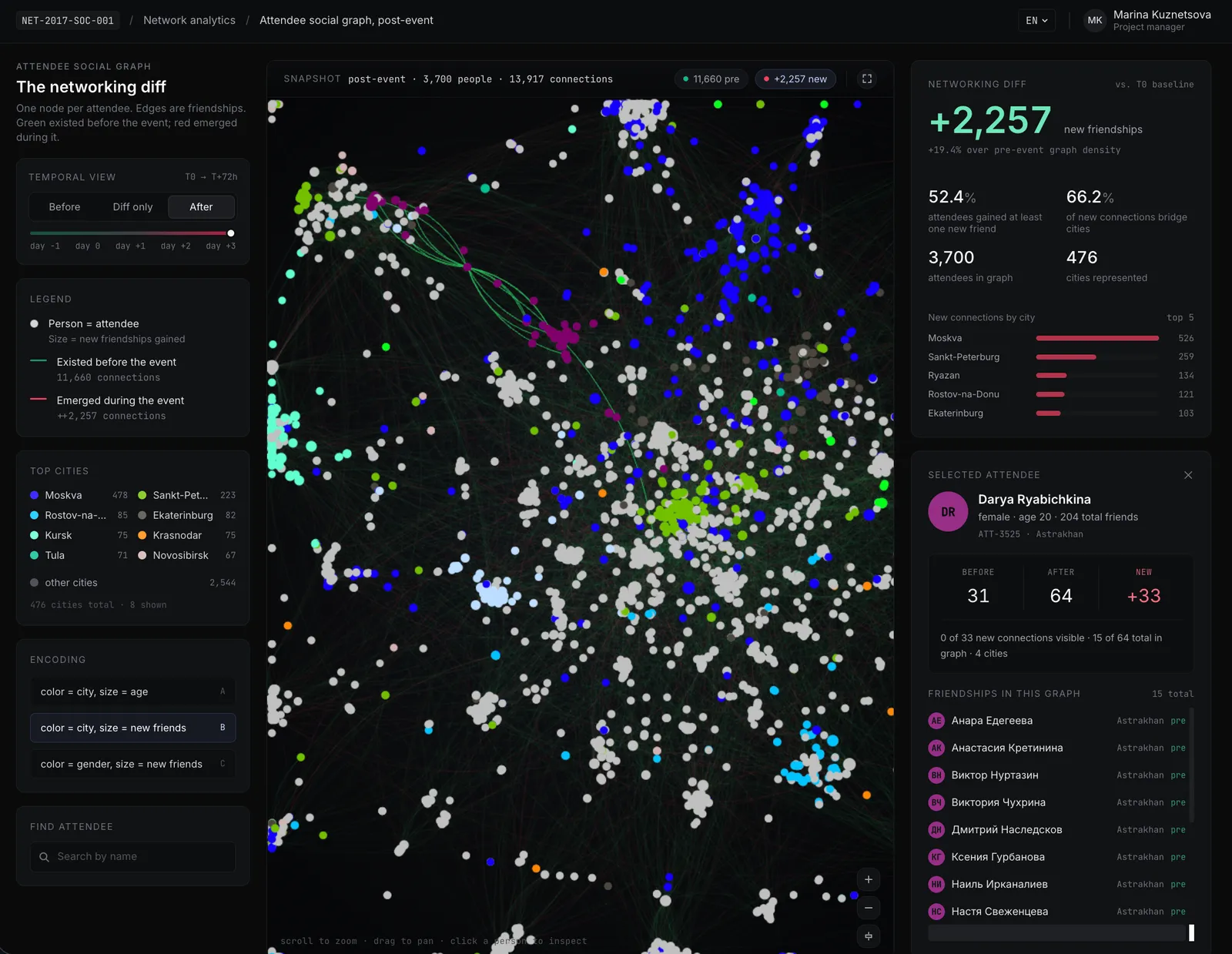
Across our work, messy signals from the field, sensors, documents, archives, social networks, and counterparties have to become domain facts someone can sign, settle, audit, dispute, analyze, or report. The screenshots below are anonymized category markers: enterprise AI automation, fraud and anomaly analytics, OSINT monitoring, and network/graph intelligence.

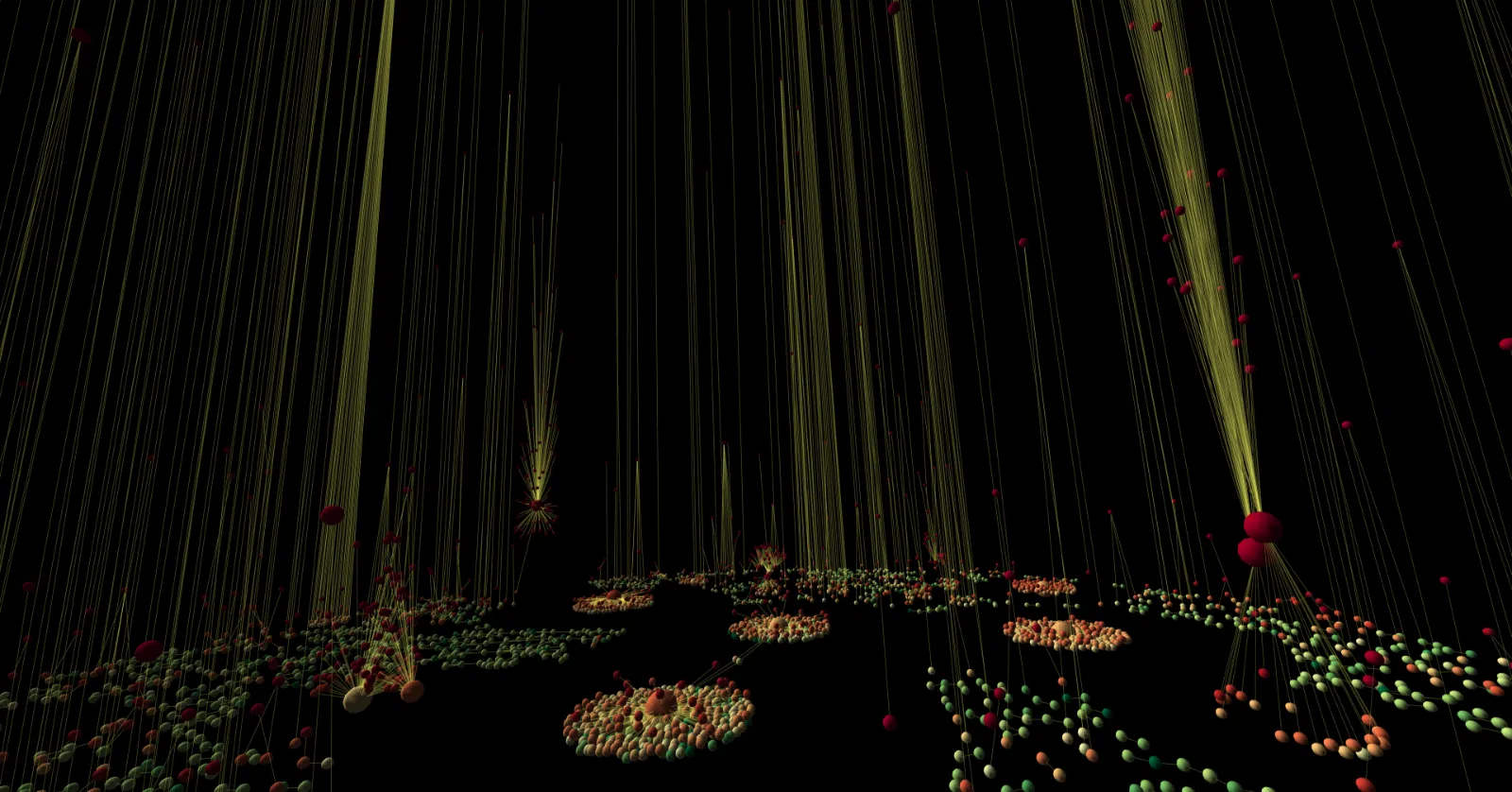
Twitter conversation in immersive VR — golden filaments rising from horizontal discs of node clusters.
Immersive analytics · WebVR · 2018

Twitter conversation, in VR

Data has a geometry. Hundreds of thousands of retweets in a walk-through cascade graph, where the shape of each propagation tells you how it spread. An organic conversation looks like a disc. A botnet funnels through amplifier accounts and looks like an hourglass. Opinion leaders broadcast as fans.

  • Information cascade analysis
  • Retweet-network topology
  • Coordinated inauthentic behavior detection
  • Influence-operation forensics
  • Immersive 3D analytics
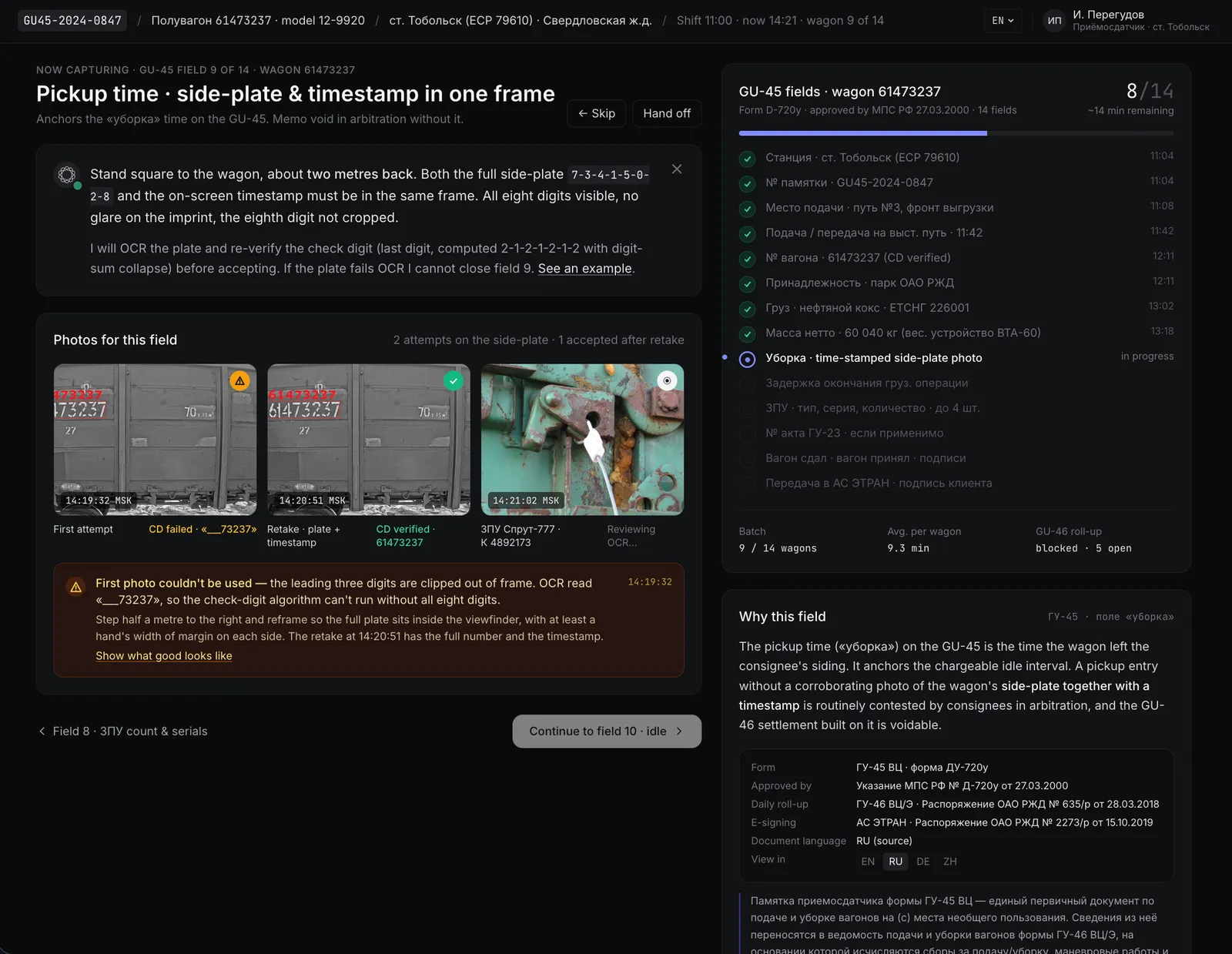
Russian Railways receiver-dispatcher console at ст. Тобольск closing GU-45 memos: AI-guided side-plate photo capture with a failed first attempt clipped on the left and an accepted retake, real form-field checklist on the right, and the GU-45 source clause in Russian with a switcher to view it in EN, DE, or ZH.
Evidence intake · Vision-language AI · 2024

AI evidence intake for field operators

An immutable record proves it was not changed. It does not prove it was right. So we put an AI next to the field operator to catch inadmissible evidence before it enters the system. It guides checklists, verifies forms against their governing rules, and checks that each photo supports the claim.

  • Multimodal document understanding
  • Domain-specific RAG
  • Rule-grounded operator guidance
  • Ontology-driven retrieval
  • Human-in-the-loop AI copilot
  • Fine-tuned LLM
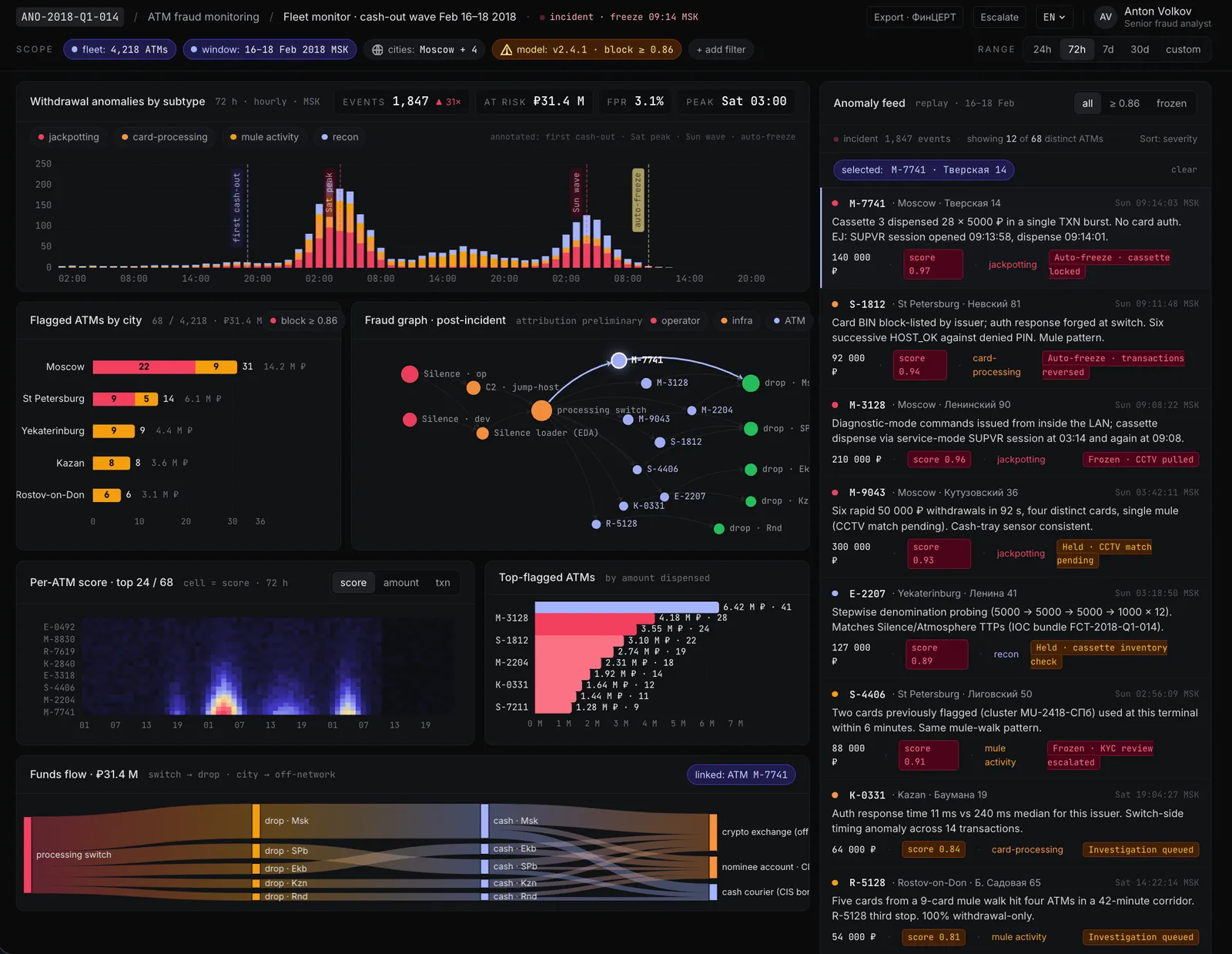
Three-panel anomaly dashboard: daily transactions and external-volume time-series, per-ATM activity heatmap, and a heat overlay of cash flow.
Forensic analytics · Banking · 2020

ATM fraud monitor

A slice of an incident console for a 4k ATM fleet. It groups withdrawal anomalies by subtype, model score, city exposure, affected terminals, attribution graph, anomaly feed, and funds-flow path, so analysts can decide what to freeze, escalate, reverse, or investigate.

  • Time-series anomaly detection
  • Fraud detection and risk scoring
  • Attribution graph and flow analysis
  • Incident triage
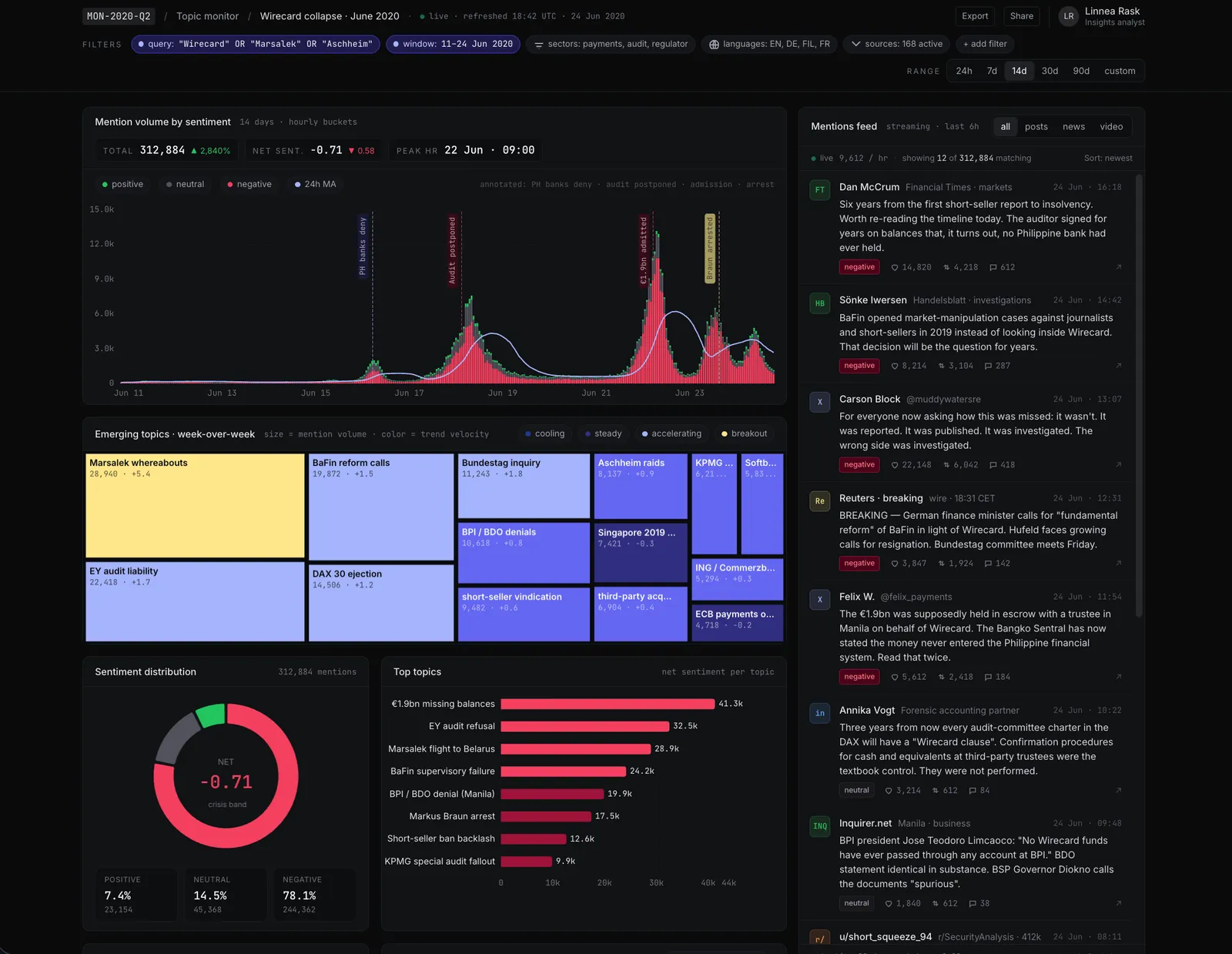
Topic-monitoring dashboard tracking a financial-fraud news cycle: hourly mention volume stacked by sentiment with annotated event spikes, an emerging-topics treemap, sentiment ring, top sub-narratives bar chart, top sources, geographic distribution, and a live mentions feed.
OSINT · Media intelligence · 2020

Narratives in motion

Real-time intelligence on the web, for analysts who need to see a narrative shift before it melts into consensus. Crawlers ingest multilingual posts, news, and source feeds; the pipeline deduplicates mentions, scores sentiment by topic, and detects emerging narratives. The analyst sees the live feed, volume, new narratives, the events behind each spike, sentiment, and the sources moving the story.

  • Distributed web crawling
  • Multilingual source ingestion
  • Deduplication and topic resolution
  • Sentiment and narrative-shift detection
  • Analyst feeds, alerts, and event annotation
// 03

What doesn’t change

The systems vary. The operating model stays the same: the people who design the work stay close to production and the work has to hold up years after handoff.

  1. i.

    Field-facing engineers and domain experts

    Our engineers work close to operators and production constraints. Our team includes domain experts, UI/UX designers, application and platform developers, DevOps, computer vision, NLP, and AI/ML engineers, and security experts. No sales staff and no outsourcing. Taste and rigor stay in-house.

  2. ii.

    Adoption is the measure

    When production needs new model work, optimization, or new inference serving, we do the research. We ship the system. The measure is adoption: new users hitting KPIs, new modules, sources, and integrations landing year after year. Every multi-year client since 2018 still works with us. The engineers who built your v1 are typically on staff when you renew v5.

  3. iii.

    Built to be audited

    Certification, approval committees, and inspection are part of the work. Regulators, counterparties, internal audit, CISOs, and counsel may need to know how decisions are made. Depending on the system, it becomes RBAC/ABAC, segregation of duties, signed events, WORM storage, retention policies, data lineage, model-version control, inference logs, and replayable audit trails.

// 04

If your system has to be trusted, talk to us

Tell us what the system does, who audits it, and what does it need to integrate with. We’ll tell you whether we can help in a single conversation.

engage@kalabi.tech